
TheBookofJules
"You must become so free that your very existence is an act of rebellion." -Albert Camus
Currently reading






Gone Girl by Gillian Flynn | BOOK REVIEW

I had to mull over my feelings a bit before posting a review of this one. I will get this warning out of the way, although I don't know if it's a spoiler or not so I will tag it as such:
(show spoiler)
I actually enjoyed my reading experience of Gone Girl. Unlike many a reviewer I did not guess the "big twist" in it, mostly because I wasn't expecting it to be revealed where it was and also because I kind of forgot about it. I think that's a good sign: when you're so thoroughly engrossed in a book that you've forgotten its main selling points, the author should get a pat on the back for that.
Gone Girl follows the story of a man whose wife disappears. All of the evidence points to him, but he is adamantly denying having any involvement in his disappearance. The interesting thing about this novel is that it is established very early that the dual narration is an unreliable one, and it's hard to figure out who is lying to you and who isn't.
I've said in the past that I dislike it when the narrator hides things from the reader, but I've never had a narrator flat out say he was lying before. I actually don't have an issue with that and found that I really liked that. I was really engaged in trying to figure out when Nick was lying and when he was telling the truth. That sort of inclusion really made for an all-encompassing experience.
If you're in the mood for something quite dark, and
then I think that Gone Girl is for you. Certainly it's worth a read, especially as the movie is coming out soon. I do have to say that I think this will make for a fabulous film.
 8
8

Austenland by Shannon Hale | Book Review

This might be one of those rare instances where I liked the movie over the book, even though I enjoyed the book, too. The issue with this is I'm not 100% sure of my objectivity. Then again, can a review actually ever be objective when the feelings of the reader surely must influence it? I think reviewer Emily May once asked this question, too. (It may have been on her Gone Girl review). My answer to that question is no, a reviewer can never be 100% objective. And you know what? I'm not going to even attempt it in this book review. I may never attempt it again. Maybe it's better to just state your feelings. After all, Reader-Response theory is perfectly valid... and maybe my favorite school of critique.
Now that I've gotten thoroughly off-topic...
I didn't enter this book blind, which is something I prefer to do when reading. I had already seen the absolutely adorable film version of Austenland which stars my doppleganger Keri Russel and who I will always have a bias for her because don't we always like people who look like us? (Or is this just me?) In the film version, Jane is this adorable, obsessed Darcy-lover and when she arrives to Pembrook Park she is absolutely enchanted. But the book differed a bit in her attitude...
Jane Hayes is in her thirties, single and has a slew of failed relationships that she could put on her resume, but probably won't because why relive the embarrassment? She has a secret love for Mr. Darcy, particularly the Mr. Darcy played by Colin Firth in the A&E version of Pride and Prejudice and always compares her boyfriends to Darcy, to the point where she will break up with them if they so much as snort... because Mr. Darcy would just never snort.
When a wealthy relative passes away, she leaves behind a trip for Jane: to go to Pembrook Park for three weeks where she will experience Regency life and perhaps have a fake unexpected romance with one of the actors playing the gentleman.
Now see... in the movie, Jane pays for this trip herself and is all excited to go. She is not embarrassed about her obsessed. She doesn't hide her DVDs - although she does keep people out of her room and I don't blame her because LOL @ the MRS. DARCY on the walls, like what? - she is sweet and shy and very much looking for romance in all the wrong places. She goes to Pembrook Park in the hopes that she will overcome her obsession and absolutely loves everything about it from the get-go.
Book Jane is a bit less likeable. She hides her DVDs in her plants, like that's a smart place to hide them, and she is judgmental and critical, often thinking herself the prettiest and smartest of the ladies at Pembrook Park. She does go to the estate in the hopes of overcoming her obsession, but she is less than impressed and even disgusted at certain things. I found reading her to be a very different experience to watching her, and I much preferred the latter.
Looking at my rating, I guess this would probably be a three-star read and one day I may come back and lower that score. But as it stands, I am definitely probably being influenced by the movie and that's why I gave it four stars. I would recommend this book for someone who wants a clean, light beach read that guarantees them a happy ending. The romance in this is sweet and the book is a bit like candy in that way. Very enjoyable, very soft -- I'm thinking a cotton candy comparison is the most appropriate. So, pick it up if that's what you're interested in.(less)
 3
3

Booktube-A-Thon: Day 1

Is anyone taking part in Booktube-A-Thon? One of the challenges is to read a book-to-movie adaptaion, and I've chosen "Into the Wild."
It's a really fun, week-long read-a-thon and I really recommend everyone try it out! :)
Check out www.youtube.com/Booktubeathon for more info.
2

If I Stay by Gayle Forman | Audiobook Review

I think that there's a lot in a reader's life that affects the rating of a book. When they read it, the mood they were in, how their day had been, what they had been reading previously, what they plan on reading next, etc. In this case, the stars aligned for my reading experience of Gayle Forman's "If I Stay," because I found it to be a nearly perfect book.
I did listen to this, rather than read it, so that my have affected my experience of it, but I honestly feel as if this is the perfect book to listen to. The reader was phenomenal, and the narration is just meant to be read aloud. The short, poetic sentences that Ms. Forman has woven together flow into each other beautifully. There were never any awkward wordings or sentence flaws that threw me out of the story.
I loved all of the characters in this story, especially the parents. When you're listening to a book instead of reading it, different things become important for you to enjoy your experience. For me, the things that became important were the character dynamics, their relationships and their dialogue. All three were excellent. Mia is a conservative teenage girl who loves her alternative family, her alternative boyfriend and her cello. Being able to hear the story from her point of view, considering she was "strangest" of them all, was really interesting. What it was like to grow up with such liberal parents and off road ways of thinking, what it is like having become someone so very different from her parents, but then falling in love with someone so very like them.
What it's like losing your parents and younger brother in one moment.
This book got to me. I did okay throughout the most of it, but the ending, where she's choosing to stay or go... I couldn't handle it. The tears were streaming down my face. I wouldn't say I was sobbing but there was a continuous trail of tears. The author wanted a reaction and she got one. Kudos to her for being able to weave a story so heartbreaking and full of hope at the same time.
4

Dangerous Girls by Abigail Haas | Book Review

-enter all the expletives-
I'm so very disappointed.
This book did the one thing I absolutely cannot stand books to do. It's a cheap ploy and it honestly made me want to cry, hence the low rating. Other books that have done this to me almost always get one star ratings, but I'm giving this two stars because of how honestly good the story is.
This could have easily been a five star read, if not for the aforementioned ploy. If the author had only gone a different route, then I would have loved this until the end. Maybe I'll raise the rating to three stars, but I'm not sure how much merit I want to give to cheap tricks. Maybe I'll lower it to one star, but I don't want to disregard the rest of the story.
What is this ploy I'm mentioning? Well... I'm not going to tell you. Truth is, what bothers me may not bother you. I've seen heaps of four and five star ratings of this book from my friends here on Goodreads, which means that this clearly didn't bother them like it bothered me. I don't want to ruin something that could be a great experience for you simply because I find it to be a poor writing technique.
So, give it a read. Get to the ploy, the trick, the cheap technique. Tell me what you think.
2

We Were Liars by e. lockhart | Book Review

Go into this book without any sort of context.
Don't read reviews.
Don't read synopses.
And definitely
do not read
spoilers.
This book is not a perfect book, but it's worth the time.
4

Book Review: A Bear Called Paddington

Book, it's not you, it's me.
I don't know why I didn't love A Bear Called Paddington; on all accounts, its adorable: a cuddly, talking bear, an English setting, accidental mayhem, etc. Perhaps it's the last point listed, but I didn't feel any magic in this story. It just felt like a very drawn out children's book where the bear kept getting in trouble over and over. His accidents didn't seem humorous to me. He was always in trouble for doing silly things, but I always ended up feeling sorry for him. I was actually hoping he wouldn't get in trouble for the remainder of the book because those scenes were just flat-out painful to read.
I wanted to love this book. I adore children's books in all their shapes, sizes and glories. However, the reason I love children's books is because they make me feel warm; there's a taste of that youthful magic we all love in their pages. I love the Disney books and anything by Ronald Dahl because they remind me what it felt like to be young and carefree. This had none of that, not for me, anyway. There was no warmth for Paddington, just exasperated. And that disappointed me

Manga Review: Red River (Volume 12)

Okay, well... I am going to write a review when I reach volume 14 since that will be the halfway point of the series, but something happened in this volume that I need to get off my chest. So, get ready for my rant, ladies and gents, because I do not know what to feel right now. Warning: spoilers will be told without spoiler tags. Read at your own risk.
So, let's talk about that rape scene, yeah?
Okay, look. So far, as a series, this is easily a four or five star manga. I'm impressed. But as a volume, this gets one star. One star for you! I've suffered through twelve volumes of soap opera relationships and I'm at my limit here. The history is awesome. The characters are awesome. But this whole "I love you and can't be with you and therefore can't have sex with you even though I'm your concubine thing"? This needs to cease and desist. I'm sick of it. At this point, I want to ram the heroine over the head with a baseball bat. I get that she's seventeen, but she's been in this world for two years. I was hoping for a bit more character development from her, especially in, you know, relationships.
And yes, Mursili is from a time where men take what they want - including women; a time where men can rape women and they can still fall in love later because it's not considered a crime; a time that is vastly different from my own. Okay, I get that. But this is on the mangaka. Why the hell did you decide to have Mursili try to rape (or actually rape? I couldn't really tell?) 12 volumes into the manga. Why did she decide to make a previously good natured and gentle character* go berserk in the bedroom once the reader has already accepted him? The heck is her motive here? Because for me, no matter how sorry he is, this character** is now ruined forever. Is it supposed to be one of those "Oh, I am at my limit and must have you!" things that seems to be so popular in porn? This series is not a hentai, so... that's a bit out of touch, really. And also it's bull shit because men can control themselves. I honestly do not even know what happened here.
I really don't know what to think. I get that it's the time period and that it's the situation, but I live in this time period and rape is heinous. The mangaka knows this because she lives in the same time period as me. She has gone through such lengths to make Mursili a sympathetic and likable character, so what is happening, exactly? Is she trying to remind us of the time period, of the type of laws that existed between men and women? Could it not have been done in another manner? Could she not have introduced this side of the character about ten volumes previously? Am I the only one really disturbed by this?
Oy. Well, I'll continue reading. The story, regardless of the whiny heroine and rapist hero, is still really good.
/rant
* Well... let's be real. He has tried to seduce her multiple times, but she keeps rejecting him for reasons, but this was the first time he'd ever been, well, like that.
**And I mean character. I've noticed that some people who've read this manga seem to want to relate the real Mursili to the one who is in the manga and were sad that he had two wives -- and the fact that he had two wives apparently means he's a "bastard". For one, two wives during this time is rather impressive, but I have to wonder how many concubines the guy had, ha. For two,this is a story, not real history and not real life.

Review: The Double Helix by James Watson

James Watson and Francis Crick made arguably the greatest discovery of the 20th century: proving that DNA is the building block of life and providing a solid structure for it. This short autobiographical account written by Watson provides an in depth - and biased - look into the discovery and also reveals the world of science, where fair play isn't always adhered to.
I remember my mother talking about Crick and Watson when I was a kid learning about DNA in school and telling me how these two men stole a woman named Rosalind Franklin's idea and research and then got all the credit for it, including a Nobel Prize. Well, my ten year old (or so) self was appalled by this. She did all the work and they got all the credit? The injustice! Reading this was eye-opening for me, because yes, Franklin did not get nearly as much credit as she deserved during the time of there discovery (this was later remedied as best as it could be), but I would not necessarily say that they stole anything from her. Although, I suppose when it comes to her X-Ray of the B Form, that's pretty debatable.
Because this was written by Watson, this is simply his perception of how things went during this time of his life. I think that he didn't aim for objectivity in portraying the people around him, but rather tried to give his opinion and point of view. I do not think his portrait of Maurice Wilkins or Linus Pauling were particularly appealing, but they were his greatest rivals in the world of DNA, so he had to villianize them to make himself the hero. As my professor said, he turned Pauling into Goliath so that he and Crick could become the Davids.
It is extremely readable, but I am not its target audience. I have to admit that had I not read this for class, I may have never picked it up. Although my career is in the science field, it is in the world of computers, not biology and genetics. I greatly appreciate the work that Crick and Watson did, as well as Pauling, Franklin, Bragg, Wilkins, Perutz, Kendrew, etc. but I did not truly understand all of the science in this. On the surface level, it is understandable and I don't think any readers will ever feel lost. That's not what I mean. But on a deeper level, understanding the impact that each scientist had on each other, the impact of each step forward, each failed experiment and each successful experiment: I think someone who has a background in this type of science will really appreciate those aspects.
Overall, I'm quite happy to have read this. It provided a detailed account of one of the most monumental moments of modern history. Recommended.
7

Manga Review: Dawn of Arcana
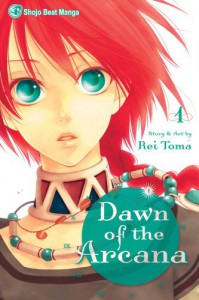
I really like stories about Tarot Cards, as can be noted in my review of Kresley Cole's Poison Princess. As soon as I realize that a story's plot revolves around Tarot, it notches up at least four cool points, which may have been the deciding factor for my four-star rating over a three-star one. I do like this - it was interesting enough for me to finish the first volume quickly and then hop right on to the second one. It is not funny like Skip Beat! or have the absolute ingenuity of Attack on Titan, but it also isn't disturbing like Love Hina (or even B Gata H Kei, but I liked that series, which might mean I'm a closet perv...). It's wholesome, it's fun: it's exactly what I want out of a manga.
Nakaba is the first born princess of Senan who is placed into a marriage contract with Caesar, the second born prince of Belquat. (And I'm really hoping that name is a foreshadowing, but we'll see.) Nakaba is sent without anyone except for her trusty servant, Loki (is the name a hint again!? Am I reading too much into this?) to fend for herself in enemy territory. But strange dreams keep Nakaba up at night and a mysterious person wants the prince dead.
DUN DUN DUUNNNNNN.
Like I said, it's an interesting plot. It's cliche, but welcome to the world of manga. And of course I had minor issues...
But it's fine. Suspend your disbelief far, far away when it comes to relationships and manga. It is a lesson I learned well as a teenager.
There was something that really made me cringe, though. No spoiler, because it's a fair warning to anyone who might want to pick this up. Caesar becomes quite forceful with Nakaba when it comes to the intimacy of their relationship, going so far as to force her to kiss him and push her to the floor. I am very convinced that if Loki hadn't come when he did, Caesar would have raped her. Yes, I'm taking the medieval time period into account, but rape is rape. It really damaged my view of Caesar as a character and I am not liking how we're supposed to think he's a stand up guy suddenly. Decent guys don't rape people, plain and simple. I really don't understand why the author included such a scene. It wasn't anything that made me throw the book against the wall in rage, but it did make me very uncomfortable.
Overall, other than that rape-y scene, I am liking this a lot and am already halfway through the second volume. I hope it stays as interesting as it is now.
4

 2
2

Review: Men Who Wish to Drown by Elizabeth Fama

"It was a magnificent death. The impact rendered me nearly insensible, the icy chill dulled residual pain, water began to rush into my lungs. A man could suffer with his death, and I daresay most do, but mine had no agony. Have you wondered what dying is like? I shall tell you the end of it, the release, which must be the same for all men: Darkness folds around you, just as soft water closes around a stone tossed into a pond, claiming it."
There are a great many Tor.com short stories I have read without reading the novel they pertain to and enjoyed immensely for their content. This is not one of them. I enjoyed this for the writing contained within the story and for the emotion that played across the text without ever dragging me into it. This, I feel, could have easily been a five-star read, but I needed more insight into the world. The writing was beautiful. Haunting, poetic, melodic and tragic. I read the story swiftly and it left me feeling wistful and nostalgic, but I don't know what my nostalgia was for. I don't know what I miss, but this story made me miss something. It left a strong impression.
(I should note that, in general, I don't really connect with letter-based stories. I find letters more impersonal than actually reading the story as it is happening to the narrator.)
It certainly makes me want to read Monstrous Beauty as soon as possible, so I suppose, if selling books is the intent of this novella, mission accomplished.

Review: Premeditated by Josin McQuein

This is f***king awesome. (Pretend I'm Macklemore.)
This book... is a mess. The reader is told the story by a very unreliable sixteen year old narrator named Dinah who is on a mission: destroy the boy who destroyed her cousin. After her cousin, Claire, committed a botched suicide attempt, Dinah found her diary; a diary which contained very detailed events of what had happened to Claire before her suicide attempt; a diary which contained the name of the same boy over and over: Brooks Walden. So, Dinah loses the black hair, the piercings and the gothic clothes and dons knee socks, bleached hair and a clean face all in the hope of enacting her sweet, cold revenge.
I was addicted to this book for the five days I listened to it. I normally listen to my audiobook CDs in the car, but I shoved my earphones in and listened to this book on my phone while I drove, cooked dinner, went for walks... basically as I lived out my daily life. And it was so worth it. I feel like listening to this book gave me a different experience than reading it. It was like watching a thriller movie. I was on the edge of my seat (or toes) the entire time, yelling at the main character, rolling my eyes and slapping my hand over my mouth in horror. Some books are meant to be listened to.
Dinah made me uncomfortable with her poorly planned vendetta and single minded determination to ruin a boy's life, but I couldn't help but like her a little. This girl certainly doesn't do anything half-assed. I actually liked all of the characters and felt like they all had many different - and interesting - layers to them. I must admit that I saw the "twist" coming from the moment our narrator met her perp, but I have to wonder if that wasn't the author's intention. There were so many clues throughout that it felt like she wanted the reader to know what would happen... we just had to wait for Dinah to figure it out.
Reading a book that like is interesting because it makes it difficult to not get bored when you know what's ahead, but somehow McQuien kept me interested. I liked hearing how far this girl would go to deal out the justice that she thought was so duly deserved, and I also liked hearing about her reservations with her own convictions. Dinah felt very real.
Recommended to people who enjoy thriller stories, YA Contemporary stories or just want to read a well-written YA once in a while.

Review: Sin Undone by Larissa Ione
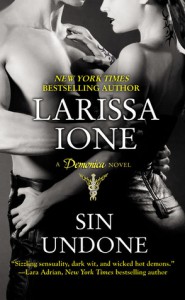
Larissa Ione writes good smut. I remember, oh-so-long ago, when I read her first book in the Demonica series, Pleasure Unbound. I was such an innocent, then. I'm a bit more experienced in the world of smut now and it takes a bit more than well done sex scenes for me to enjoy a book, but this plot had a lot going for it.
Sinead is an Assassin Master who sort-of-accidentally unleashed a plague upon werewolves that has been "lovingly" renamed Sin Fever. She has the unique ability to be able to give someone a disease simply by touching them, but when that goes wrong and that disease spreads to more than her intended victim, she realizes that she may have just accidentally caused a civil war.
Conall is a dhampire, a werewolf/vampire hybrid, who works at Underground General (a demon hospital) as a paramedic. When Con first met Sin (in the last book), they immediately felt a draw to each other that led to a quick tryst in the supply closet. Since then, and since she has unleashed a virus upon his species - albeit unintentionally - he wars with himself simultaneously hating her and wanting her.
So, yeah. There's a lot going on in this book: Civil war between werewolves; a virus that is killing off wargs at an alarming pace, creepy guys on horses, assassins and ownership, and, of course, the undeniable attraction between Con and Sin. For the first half of this book, I was really leaning at four stars, going on five. What brought it down for me was two things:
1) I am really having a hard time stomaching the whole male-over-female dominance thing. Sometimes, I can understand it, like when it's with werewolves and that's their pact mentality or what-have-you. But with Sin and Con? It felt weird. I don't remember being this uncomfortable since the second Demonica book, between Shade and Runa which I almost gave two stars because I sort of felt like he wanted to own her. While this book wasn't as bad, I certainly didn't think Con saw her as an equal until maybe the last 10% of the book. He kept seeing her as something to be protected and taken care of or even used, and I just wanted to scream at him: She is an assassin master for Pete's sake! The chica can handle herself.
2) Oh goodness, the sappiness at the end. Haha. I think this is just me, but that super happy ending at the end almost made me cringe with the corniness. A certain amount of corny, especially after all that Ione makes her poor characters go through in her novels, is appreciated, but I really felt like this book in particular took corny to a new level. I'm not saying this is a bad thing - some people might adore the ridiculously happy ending - it just wasn't for me.
Overall, I do really enjoy Ione's Demonica books. A lot. They have been fantastic reading experiences and I'm sorry to say goodbye to this series. It's the end of an era. I am very excited to start her Lords of Deliverance series, though, and I hope to see a few familiar faces in them.
5

30 Day Book Challenge: Day 17 - Favorite Quote from Your Favorite Book

Oh, what? This is over? No. Shhhh. It's okay. I'm going to continue anyway until I get to the thirty days, haha. YOLO!
... I may be using that wrong.
Well, Zen and the Art of Motorcycle Maintenance is not my favorite book, but it is chock full of memorable quotes. My favorite book is The Hero and the Crown, which I read when I was ten and therefore can't remember any quotes from it. My favorite quote from ZAMM is very short, but very precise and, I think, very true.
"Nothing exists outside of our imaginations."

Review: The Graveyard Book by Neil Gaiman
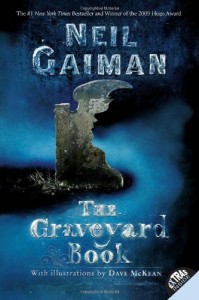
The Graveyard Book is a deliciously creepy tale of a young boy who is raised in a graveyard by the dead. Nobody Owens ran to the graveyard when he was a baby after his parents and older sibling had been murdered. When the ghosts of the Owens family - a nice family who had always wanted children - saw him, they decided to keep him immediately. And thus, the graveyard became the baby's home, and Nobody became his name.
I've only ever read Stardust by Neil Gaiman before, but I think I'm starting to understand his style: a little bit of creepy, a little bit of action and a whole lot of magic. There are ghosts and ghouls abound in this book, as well as secret orders, an ancient tomb, a spirit animal - or what I think is a spirit animal, anyway - and a man who is both dead and alive. Nobody can "fade" himself and haunt a person and uses these tricks to his advantage to get out of some sticky situations, as well as for dealing justice at his school when needed.
I listened to the audiobook version of this, which was narrated by Neil Gaiman himself, and wow... I really recommend it. I'm in the car for three hours a day because of my job and my transit to school and this really added a nice little kick to my day. Even the kids I watch liked it and kept asking questions about it! Gaiman has a very versatile voice and can do heaps of different character voices, which always made me laugh. He also has a very soothing voice, so be careful lest he lull you to sleep like he did to me once.
This book is magic. Gaiman himself is probably magic. Highly recommended in whatever format you choose.
